Tag: Travel

  • Malta

    Photo albums fill my bookcases. One for every year since 1974 and one for nearly every trip I’ve taken. I have just been going through the photos taken over the winter. Hundreds and I will have to choose a few that are representative.

    I’m not sure how we decided to go to Malta but it was a good choice. We were charmed by the island and its history. A rocky limestone cropping in the Mediterranean at the intersection between Europe and North Africa, it was first inhabited 7000 years ago. Although everyone speaks English (it was an English colony for 150 years) Maltese is the language we heard everywhere. It developed through years of invasions by neighboring countries. Most significant influences are Sicilian-Italian and Arabic.

    Arial photo of Valletta.  By CatalinBindiu – Own work, CC BY-SA 4.0, https://commons.wikimedia.org/w/index.php?curid=51396861

    I found this photo online, it gives a good perspective of the city and the country as a whole, although it doesn’t capture the steepness of the city.

    We stayed at two different Airbnb apartments in Valletta, the capitol city and another in Burgu, just across the harbor. The first was close to the water which meant that we had to walk up a steep hill to get to any other part of town. All were in old buildings built of, what else, limestone.

    The stairs leading down from our first apartment. The steps are worn from hundreds of years of footsteps.

    The apartment in Burgu was charming with a kitchen in the cellar, a small balcony off the second floor living space and two steps up to the tiny bathroom. A treacherous climb for two senior travelers.


    Public transportation was impressive. At the city gates, a fleet of buses go to every corner of the island, few taking more than an hour to get to any location. A forty-five minute bus ride took us to Marsaxlokk a town known for its colorful fishing boats. We had lunch overlooking the harbor.
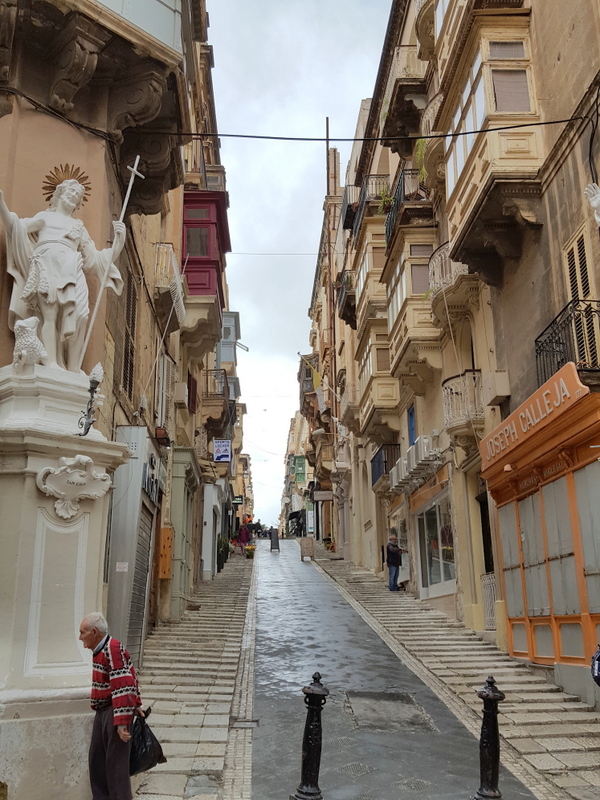
    A typical steep street leading up to the city center. The balconies on the buildings are found all over the island.
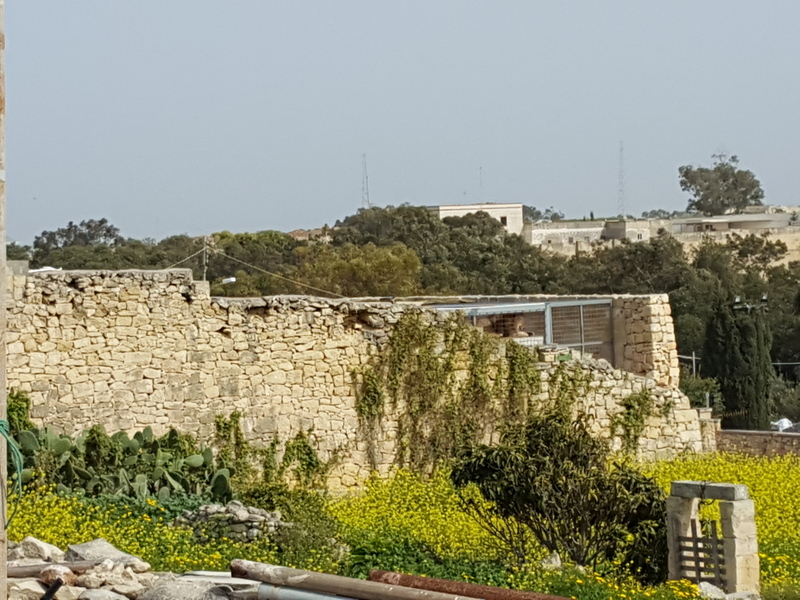
     

    One day we visited the village of Siggiewi and the Heritage Limestone Park and Gardens. The displays showing how limestone has been cut throughout the ages were fascinating. No machinery was used until after World War II.  There are temples built of limestone that are 6000 years old. It was hard to imagine how those early people could carve stone to make those structures. As we walked back to the bus stop we heard a loud roar, I said it sounded like an elephant trumpeting, Max said it sounded like a lion. We looked back and, it was a lion.

  • The Simple Life

    A few weeks ago when I went to Pennsylvania we stayed in the town of Intercourse. It is a name that often causes snickers or raised eyebrows. It seems incongruous for a town that is in the heart of  Amish country. Apparently in the 1700s the town was called Cross Key after a tavern by that name, or perhaps because two main roads intersected there or maybe because intercourse was a term used in those days to signify social interaction and support in the community. There seems to be some haziness about the origin of the name. For some reason, the name was changed to Intercourse in 1814. Some time in the 1900s there was an attempt to change the name back to Cross Key, but people in the village didn’t want it changed.

    The countryside around the town is farmland with rolling green hills and neat farms every few miles. The farmhouses are large but dwarfed by the bigger barns and silos. The remarkable thing is that many don’t have electricity. I saw farmers plowing their fields with teams of five or six horses and clothes hanging to dry from long clothes lines.

    Farms with buggy and car on the same road.
    Farms with buggy and car on the same road.

    In the village the enclosed black, horse drawn buggies are seen everywhere. They drive the busy highways seemingly undaunted by the cars and trucks speeding along. Scary! The Amish are Christians and believe in living very simply. They are a sect of Anabaptists who came from Germany to avoid discrimination following the Reformation. They eshue modern technology like electricity, tractors and cars although there are some who do use some things like tractors. The Amish dress is simple, the men we saw wore belt-less pants with suspenders and had untrimmed beards. The women were wearing white bonnets and calf length dresses. We saw men, women and children riding kick bikes, sort of like a bicycle without a seat and propelled by kicking.

    Village parking lot
    Village parking lot
    Buggy in Town
    Buggy in Town


    The town itself is comprised of shops selling quilts and food items and rustic furnishings. It is self-described as “quaint”. Friday and Saturday there were hordes of people wandering in and out of the shops. The parking lots were full.

    Sunday morning we awoke to a silent town. Every shop and restaurant closed, parking lots empty and the only people we sighted were Amish families, in black suits and dresses, walking to church.

    Kick Bike
    Kick Bike


  • More Ireland

    It is fun to travel and fun to come home. We arrived late Tuesday night after missing a connection and hanging out for five hours in the Toronto airport before getting another flight.

    Here are a few of the photos (out of hundreds). We traveled south from Dublin sort of following the coast. We were as far south as Cobh in Co. Cork, west to the Dingle Peninsula in Kerry, up through Galway, Mayo and Donegal before turning east into Northern Ireland. We stayed in Derry and then in Bangor, east of Belfast, before returning to Dublin and then home. The entire country was green, green, green.

    We visited castles and ruins and a couple of museums but mostly enjoyed the beauty of the countryside and the friendliness of the people.

    Dingle Peninsula
    Dingle Peninsula

    These rock lined fields are typical of this part of the country. We were told that long ago each field had a separate name. Note the road, it is narrow with little room for vehicles to pass. I was driving and didn’t want to meet a tour bus on one of these curves.

    A stone house on the Dingle Peninsula
    A stone house on the Dingle Peninsula

    We would like to have gone into this building and asked about how a roof made of stone is constructed and works in the wind and rain of the area but it was closed.

    Father Dyer's Folk Village in Glencolumbkille, Co. Donegal
    Fisherman’s cottage in Father McDyer’s Folk Village in Glencolumbkille, Co. Donegal. It is one room with an open fire at one end with a hole in the roof for smoke to escape.

    The Folk Village Museum is a cluster of several small cottages, called a ‘clachan’, perched on a hillside overlooking the sandy curve of Glen Bay Beach in the Gaeltacht (Irish-speaking area) of South West Donegal. It was started by a priest, Father McDyer. At the time of Father McDyer’s arrival in 1951 the parish of Glencolmcille was suffering from a long-standing cycle of unemployment and emigration. Over the next three decades Father McDyer worked to help break this cycle, lobbying for amenities, organising community projects and supporting the development of local industries, many of which, like the Folk Village, are still successful today. (quoted from website) It shows a glimpse into daily life in past centuries. It was a hard life.

    We had never seen this kind of thatching before. The ceiling of the houses are bog wood (wood dug from under the peat bogs, left there eons ago when there were forests). Thatch is laid over that and secured with ropes made from twisting together local materials.

    Open fireplace in one room cottage.
                                      Open fireplace in one room cottage.


    Map of Ireland made of stone from each county.
                             Map of Ireland made of stone from each county.

    This map is striking and the women in the visitor’s center were excited about it. It had just been dedicated two days before we were there. Each county provided the stone for their representation. Note the Gaelic county names.


    A hedge school. When the English ruled the country it was forbidden to speak or teach Gaelic. It would be taught in these little hidden spaces.
    A hedge school. When the English ruled the country it was forbidden to speak or teach Gaelic. It would be taught in these little hidden spaces.


    Several areas along the west coast are Gaelic speaking. The road signs are in Gaelic and English. We were surprised to find that people living there speak Gaelic, or Irish as some call it, in their every day lives.

    A field with drying peat. We kept seeing fields with mounds. It took us some time to realize that after the peat is cut, the brick sized pieces are made into little pyramids and left to dry.
    A field with drying peat. We kept seeing fields with mounds. It took us some time to realize that after the peat is cut, the brick sized pieces are made into little pyramids and left to dry.


  • Coastal Drive

    We’ll be heading home in a few days. I have so much to say about our Irish adventure but need to organize my thoughts. I’ve mentioned the weather. I’ll mention it again because our photos can’t do justice to the beauty of the country. So often we see the sun shining across spectacular landscapes but can’t stop to get a photo. The sun and rain change within minutes. We can be driving in a heavy rain and ahead of us the sun is shining. It seems like the most striking photos are under gray skies.

    Today we drove along the Causeway Route from Carrickfergus to Bushmills.The road winds along the coast with great views of cliffs and mountains ahead. I was driving and happy to be hugging the left side of the road. In many places the right lane had only a stone wall between it and a drop into water. It looked like it would be an unpleasant roll down a rock cliff.

    The road we took is also a bicycle route. It didn’t look like much fun to be cycling in the rain with gale force winds one area. It was also scary to be driving on a narrow, curving road with a cliff on one side and drop off on the other and turn a curve to discover a number of cyclists. Slow to a crawl and wait for a place where there’s a little visibility of oncoming traffic.

    Easier to go through than around.
    Easier to go through than around.
    Farms and the sea
                                   Farms and the sea
    Cliffs along Causeway Coast Highway.
                                    Cliffs along Causeway Coast Highway.


  • Frustrating technology

    Ireland is so green! So many shades of green. Understandable since there is a mix of sun and rain every day since we’ve been here. The south was notable for narrow roads lined with hedgerows right to the edge of the road making it difficult to see what was behind them. Hillsides are divided into different fields by rock walls.

    Approaching Galway is an area called The Burren. It is a vast area of limestone pavements where only some alpine plants grow. It’s been said that the area “yields neither water enough to drown a man, nor tree to hang him in, nor soil enough to bury him.”

    We’ve traveled north though Gaelic speaking country with wide vistas and no hedgerows or stone divided pastures. There are mountains and lakes (loughs) and spectacular scenery.

    There is much to say and many photos to share but the computer I’m using is a problem. I’ll have to recreate the trip with photos when we get home next week. Incredible scenery, friendly people, ancient history. A great trip.

  • Dingle

    The Dingle Peninsula is reputed to have some of Ireland’s most stunning scenery.  We are in a Dingle hotel overlooking the harbor but we can’t attest to that. We’re in the midst of what, in Ipswich, we’d call a Nor’easter. Gale force winds, upside down rain and no visibility. No matter, the people are friendly, the food good and we aren’t on any schedule.

    View of the Dingle Harbor today.
    View of the Dingle Harbor today. Even the water is hidden, no sign of the mountains behind.

    We are wending our way north along the coast and will end up in Belfast. I’m sure we’ll see some beautiful country.

    Earlier in the week we toured the Jameson’s Distillery in Midleton. We had been given plastic raincoats in case it rained during the tour. It didn’t but the rain gear came in handy today when we ventured out for lunch. Umbrellas were useless in the wind. Across from the restaurant we watched disappointed travelers disembark from tour buses. There were probably fifteen or twenty buses. The Dingle Peninsula was to have been one of the highlights of the tour.

    Our accommodations have varied from a posh hotel to pleasant B&Bs and an old seaside hotel that had seen better days. The town of Tramore reminded us of Salisbury beach with lots of rides and arcades. The TV in our room made us think of our first TV given to us by Max’s parents in 1956 when they moved California and gave us theirs. It had a 15-inch screen and was black and white. This one had color.

    TV at O'Shea's Hotel
              TV at O’Shea’s Hotel, Tramore, Ireland

    Watching a Euro 2016 football game on it was a challenge. We could follow the white dot (the ball) and see figures in different colors running around. The details weren’t so clear.

    While we were out for lunch we bought a basket of local strawberries in honor of today’s Strawberry Festival at home.

  • More on travel

    I wrote last week about the joy of anticipation and planning a trip. Twenty-five years ago I spent two years planning a six month round-the-world trip. I read travel guides and essays, wrote away for brochures and information, telephoned airlines and travel agents and spent hours on the research. I took a class on solo travel and went to lectures by travelers. I joined Hostelling International and Servas, an international hosting organization. To join Servas required a lengthy application with an essay about myself and an interview with a member.

    I carried cash to change into foreign currency and joined American Express where I could write personal checks at any of their offices worldwide to obtain more funds. I left a list of cities where friends and family could send mail to me through General Delivery.

    At the airport of each country I bought a Lonely Planet Guide Book. It gave all the information needed for that part of the trip. They were heavy so I had to abandon each one as I left the country to move on.

    Early this May I started planning a month long trip to Ireland. I booked our flight, car rental and first three nights accommodation online after a few hours of research. We’ll use the road atlas of Ireland but mostly we will be depending on the internet. We’ll get cash in euros or pounds (Northern Ireland) from ATMs. Google Maps will get us from one place to another, We’ll send and receive emails to keep in touch and check the Boston Globe website to keep up with what’s happening in the world. (But, I will not read anything about Donald Trump or the election coverage).

    Technology has changed so much of our world but I wonder if it has taken away some of the sense of adventure from travel.

  • Travel Planning

    “Travel is the only thing you buy that makes you richer” Anonymous

    The planning and anticipation of travel is a pleasant and important part of a trip. This summer we will be spending a few weeks in Ireland. I’ve spent hours on the internet, have several books including the AA Ireland Road Atlas showing the tiniest villages and roads. I’ve an old DK Ireland Guide book from a trip thirteen years ago and a new DK Backroads of Ireland. I have Rick Steves’ latest book on Northern Ireland and three maps (probably not needed with the atlas). I will take along Ireland: A Traveler’s Literary Companion. It has excerpts from works by 15 Irish writers.

    My daughter teases me about my traveling library. She says my books take up most of my bag. This has changed a bit. I can now carry books on my Kindle but not the guide books. They definitely need to be paper.

    Ireland seems to have gained a reputation as a foodie country with several cooking school offering classes to visitors. I’m looking forward to checking that out. On my visit in 2000 I was amazed to twice be served a plate of food bearing three kinds of potatoes. There were mashed, boiled and fries in addition to meat and the ubiquitous cabbage.

    On previous visits the pubs were wonderful places to hear music and meet local people but thick cigarette smoke made it less fun than it might have been. It seemed like everyone smoked, there were always teenagers sitting in the corners of the pubs puffing away. A few months after my last visit, smoking in workplaces was banned (March 2004) making Ireland the first country in the world to institute an outright ban on smoking in workplaces, this included all pubs. I was amazed that it could actually happen there.

    A friend who has a B&B in Ireland gave me this recipe.

    Irish Soda Bread

    4 cups flour

    1 teaspoon salt

    1 teaspoon baking soda

    1/2 cup butter

    1 egg, unbeaten

    1/2 cup sugar

    2 teaspoons baking powder

    2 teaspoons caraway seeds

    1 cup raisins

    1-1/2 cups buttermilk

    Sift together all dry ingredients except for baking soda. Cut in the butter. (Go through with fingers.) Add raisins. Add milk, egg, and baking soda. Mix, not completely, just until moist. Knead for a few minutes- not too much. Place in a casserole dish. Brush with egg yolk. Bake for one hour at 375ºF.

  • Iceland

    All good things must end and so our adventures in Sweden and Iceland are now just memories. The final part of the trip took us to Iceland where we were awed by the magnificence and grandeur of the landscape. It is vast and rugged and wild and beautiful. I had thought that I’d feel about Iceland much like I feel about Alaska, I’m glad I’ve been there but have no desire to go back. Instead I would eagerly return to Iceland.

    I was surprised to learn that the entire population is only 320,000 in an area as large as all of the British Isles combined. Two-thirds of the people live in the greater Reykjavik area. That leaves the remaining residents scattered throughout the country, almost all along the coast. The interior is covered with glaciers and mountains and rock.
    Geothermal heating provides most of the heat for homes and industry. Even many of the sidewalks in Reykjavik are heated in the winter to be kept ice free. The country is very young and still changing with glaciers melting and volcanic activity ongoing.
    The Icelandic language seems very difficult to me but fortunately nearly everyone there speaks English. The language was brought by the Norwegian and Celtic settlers in the 9th and 10th centuries. Iceland was so isolated that it has had little outside influences to change it. Other Norwegian and Celtic countries languages have been modified over the years by the influence of other European countries.

    Moss covered lava fields cover vast areas. Outside of farming areas along the coast, there is little vegetation.

    We took two day long tours. Along the way We passed through the town of Selfoss. With a population of 6500 it is the largest “city” outside of the Reykjavik area. That’s only half the population of Ipswich. Wow. It is in an area of rich farmland making it the major shopping area.

    One of our tours took us to the popular sites of Gullfoss, Geyser and Thingvellir National Park. All spectacular sights. Geyser is an area of many acres filled with bubbling, boiling springs and geysers. The waterfall Gullfoss is maybe the most popular tourist attraction in Iceland. It has a boardwalk and stairs leading down to viewpoints and a restaurant but has not been otherwise commercialized.

    Gullfoss, wider, higher and more powerful than Niagara Falls.
    Gullfoss, wider, higher and more powerful than Niagara Falls.

    We only stopped in Thingvellir National Park for a brief visit but I was captivated by the landscape. Great cliffs, valley’s, a lake, rivers and huge cracks in the earth. It would have been worth a whole day’s visit. Game of Thrones fans might be interested to know that some scenes were filmed there and in other parts of the country.

    A crack or fissure in the earth.
    A crack or fissure in the earth.

    The second tour took us along the south coast. Along the highway on one side was rich green farmland dotted with sheep and horses, on the other side tall cliffs with snow topped mountains in the background. We visited a glacier, two other waterfalls and a black sand beach with an unusual columnar basalt wall at the back.

    Black beach with a cave and cliff of vertical rock formations caused by lava flowing and cooling.
    Black beach with a cave and cliff of vertical rock formations caused by lava flowing and cooling.

    Our final stop was the Skógar Folk Museum. The most interesting feature of the open air museum were the sod covered houses. The houses are of wood but only the fronts are visible. The rest was encased in sod with a few windows peeking through.

    Skógar Folk Museum. One of the sod covered houses.
    Skógar Folk Museum. One of the sod covered houses.
  • A Visit to Laponia

    In addition to reindeer herding, my Swedish friend, Sonja, arranged a unique trip for us. Sixteen women from six countries were introduced to the Sami culture in several ways. We crossed the Arctic Circle on the first day of our trip. We would not stay in hotels or eat meals in restaurants.

    Our first night was spent in a small hostel. We drove forty minutes over dirt roads to dinner at the home of Sonja’s cousin Valborg. She had prepared sliced fresh salmon that she had marinated, cheese, three kinds of homemade traditional breads and vegetable soup. The vegetables were grown in her garden and preserved in a cold cellar over the winter. Turnips, carrots, potatoes and onions along with seasonings. Dessert was an assortment of rich pastries that she had baked.

    Valborg's home overlooking a lake.
    Valborg’s home overlooking a lake.
    Dinner at Valborg's home. Tables in the living room and dining room for sixteen.
    Dinner at Valborg’s home. Tables in the living room and dining room for sixteen.

    Valborg is widowed but still lives alone on the farm where she’s always lived. Although she no longer keeps animals, she still maintains a large garden. Buses from the city, 150 kilometers away come once a week, It takes careful planning to make a shopping excursion. Valborg’s house is painted a dark red which seems to be typical. We saw similar houses every place we went. When we returned to our hostel at midnight, it was still daylight.

    Our accommodation for two nights was in the small village of Pelkam, one of the tiny, wide spread villages that dot the vast forests of the north. It was once a thriving Sami community now only three families remain. The last children born in Pelkam were born in the early 1980s. We slept in bunk beds in a small hostel, once a school house. In this remote area children sometimes lived days away from a school. They lived at the school and went home only for Christmas and summer. The Sami women prepared our meals in the hostel kitchen. Breakfasts of oatmeal, sliced ham and cheese and an assortment of breads. Lunch and dinners were meat, reindeer, pork or salmon with vegetables. They must have vast freezers, the village is 70 kilometers from the nearest town with shops or a food market.

    The dirt roads and vast forests of Laponia
    The dirt roads and vast forest of Laponia

    There are very few signs of habitation in this part of the country. Henrik, a Sami reindeer owner led us on a forest walk and explained the needs of the herd. Reindeer live on a kind of lichen that grows on trees in virgin forest. Trees should be at least one hundred years old to support deer herds adequately. The livelihood of the Sami people is being threatened from two directions. There are plans for a huge wind farm in the grazing area and there is widespread deforestation, probably for paper production. The old trees are being replaced with fast growing pines imported from Canada but they don’t provide the right conditions to support the reindeer.

    The lichen that feeds the reindeer. It hangs from old trees.
    The lichen that feeds the reindeer. It hangs from old trees.
  • A Change of Scenery

    We’ve left the land of raspberries and blueberries for a week of pineapple and papaya. Our daughter Laura has bought a little place in Las Terrenas, Dominican Republic. She and I arrived yesterday for a short visit. The weather is just a bit hotter than home and sticky but the beach is gorgeous and the town unchanged except there are not nearly as many tourists.

    Laura is hoping to rent it occasionally to people seeking a place to get away from the responsibilities of life. Our friend Junior, the young gardener we met last winter greeted warmly this morning and a short time later returned with a bouquet of flowers that he’d cut from the garden.

    This is the sweet little condo unit.
    This is the sweet little condo unit.

    The view from our porch this morning. It is a tropical garden.
    The view from our porch this morning. It is a tropical garden.
    This beautiful cactus had just a few blooms when we left in March.
    This beautiful cactus had just a few blooms when we left in March.
    This cactus is spectacular, covered with blossoms. I had no idea cacti could be so colorful.
    This cactus is spectacular, covered with blossoms. I had no idea cacti could be so colorful.

    We’ve been making lists and lists. The house is furnished with the requisite beds, chairs, etc. but there are no dishes or linens or kitchen supplies. Tomorrow we plan on a shopping trip to Santo Domingo.

  • It’s a Hard Life

    This is my last week in Las Terrenas. It’s too soon to leave. The weather has been perfect all winter. It’s been hard for us to imagine what the Massachusetts contingent has experienced.

    We had two visits in February, the time passed all too quickly. Our daughter Laura visited and took home an orphaned puppy. A week later our son Aaron and his friend Nancy were here for a week. It was nice having them all with us.

    Popi, Laura's new love. One lucky little puppy.
    Popi, Laura’s new love. One lucky little puppy.

    A few final observations on life here. I’ve mentioned the motorbikes that are the main mode of transportation along with quads. They are everywhere, zig-zagging through the narrow streets, competing with SUVs and pedestrians for space. Children sit in front of their parents on the bikes and I’ve only seen a half dozen people wearing helmets in the entire time I’ve been here. Vehicles park wherever they can find a spot, either side of the street, on the sidewalk, in any open space. It is chaotic but seems to work.

    Yesterday we saw a man pressing sugar cane through an interesting contraption. Unfortunately I didn’t have the camera with me. He gave us some of the juice to drink. It was a pale green watery liquid and was delicious. It was sweet but not intensely so, and had a grassy flavor. We liked it a lot.

    The gardens around our house are beautiful, flowers just bloom and bloom. Every place we look are blossoms of bougainvillea and hibiscus and orchids. Many of the flowers are unlike any we’ve ever seen.

    The view from our veranda looking across the pool.
    The view from our veranda looking across the pool.

    My final French lesson will be Monday morning. I think my comprehension has improved and my vocabulary for sure but learning a new language is hard, at least for me. Spanish and French are widely spoken here but we also go to a German restaurant frequented by many Germans. There is also an Italian community. We never seem to get it quite right, should we be saying si or oui or merci or gracias or danke or… We’re very good at Hola though.

    Woman selling fruit on the beach.
    Woman selling fruit on the beach.
    spectacular flower that grows in our garden. Wikipedia calls it a Lobster flower.
    spectacular flower that grows in our garden. Wikipedia calls it a Lobster flower.
  • Eating in Las Terrenas

    It’s only when traveling in a developing country that one can truly appreciate the variety and quality of food available to us at home. There we find fruits and vegetables of every imaginable kind from countries some of us have never visited or perhaps known existed. It is very different here in DR. There is one well stocked supermarket where good meat and staples like rice and coffee and cleaning supplies are available. There are dozens of small mom and pop markets lining the streets. We shop at one where we can buy unrefrigerated boxed milk, cereal and wine. Eggs are never refrigerated here.
    It surprises us that in this lush and fertile country, fresh vegetables are difficult to find. Tomatoes and peppers are plentiful and excellent but no green vegetables. Occasionally we find a few green beans or a head of broccoli but they are limp and tired looking. Iceberg lettuce is available at some of the stands but the heads are tiny and limp.
    Bananas are plentiful and everywhere as are pineapples, limes and oranges. Guava and avocado are also sold, in the market, at street stalls and from basins carried on the heads of young women on the beach.
    We had some passionfruit juice a few days ago. It led to a discussion, Max insisted it was a blend of juices, I thought it was a distinct fruit. Wikipedia to the rescue. It is the fruit that I kept seeing at the fruit stalls and didn’t recognize. They are light brown, smooth and oval, like an egg, about the size of a lemon, and have a stem at the end. According to Wiki, they are one of the most delicious fruits in the world. Hmmm, I’ll check that out.
    The thing about food here that impresses us the most, whether we are eating at a tiny local cantina, a beach shack or one of the more upscale restaurants. The food is always excellent. Fish is a few hours out of the water, meat well cooked and everything delicious. Meals always come with a simple salad (iceberg lettuce and tomatoes) and french fries, or home fries or rice. I’m convinced that the reason everything is so good is that it is freshly prepared for every meal. We aren’t being served mass produced meals or pre-frozen fries. We don’t mind that it takes a bit longer to prepare, we sit with our feet in the sand and watch the waves and the boats and people walking the beach.

  • Toronto to Winnipeg

    The city sprawl of Toronto is extensive. It takes a while to be clear of it but eventually all we see are trees, predominantly birch but lots of pine also. Now at the end of October the leaves are yellow and gold. The brilliant reds and oranges that complement the yellows in our New England foliage season are missing here.

    The woods are dense, relieved often by ponds, streams and marshes. There are long stretches without roads or any sign of habitation. Occasionally we passed a village, some small houses with pick-up trucks in the drive, unpaved roads and, little sign of any prosperity. They looked more like fishing camps. After so much wilderness we arrived in Winnipeg the capital of the province of Manitoba. I am embarrassed at how little I know about Canada’s geography and history other than as it was intertwined with ours when the British, French and American’s were fighting over the northeast territory.

    Winnipeg is a thriving and metropolitan city of 750,000 people, over half of the population of the entire province. There are wide streets and boulevards with few buildings over eight or ten stories high. We took advantage of a four hour layover in Winnipeg to take a short tour of the city. We visited the Capital building, an imposing building of Manitoba limestone, marble from Vermont and Italy with classical design and a majestic dome, walked in a lovely park with fall flowers in full bloom and visited the Basilica of St. Boniface, a strikingly modern church built within the facade of one that burned down many years ago.

    Inside the state capital building.
    Inside the state capital building.

    Assiniboine Park
    Assiniboine Park

    The downtown area around Union Station has become a huge complex of shops and restaurants with cobbled streets, a skating rink and a skate boarding park. It is part of a renovation of the old railroad buildings. The Canadian Museum for Human Rights museum is under construction to be completed in 2014. It will be the first Canadian National Museum that is located in the national capital of Ottawa.

    Like Toronto, Winnipeg has a hugely diverse population with 50 distinctly different ethnic neighborhoods. Canada with it’s vast space and stable government must be an attractive place for immigrants. Immigrants are only part of the ethnic diversity. The indigenous people of Canada are divided loosely into three groups, First Nations, Inuit and Metis. The Metis are people of mixed blood from the early days when the French and other Europeans married into the indigenous population. These groups have many sub-groups, all contributing their own customs and culture.

    The altar in St. Boniface Basilica. The central figure represents Christ with open welcoming arms.
    The altar in St. Boniface Basilica. The central figure represents Christ with open welcoming arms.
  • My Summer Vacation

    What I did on My Summer Vacation was often the first assignment of the school year when my children returned to their classes in September. I thought I’d make it the first blog of the school year even though I don’t go to school anymore.
    I just returned from eight days in Michigan visiting my sister, Beth. We drove north to see her son’s family in north-central Michigan. His little girls are four and two; they kept us busy. We played games and read stories and entertained them for two days before moving on to our cousin in the western part of the state.

    Cousin Paul lives two blocks from Lake Michigan in the charming little town of Frankfort. We spent a day visiting Sleeping Bear Dunes National Park where we watched crazy people run, slide, tumble down the steepest sand dune I’ve ever seen. Once at the bottom they could swim/wade in the lake but then had to make the daunting and treacherous climb back to the top.

    Long way down, longer way up!
    Long way down, longer way up!

    Sleeping Bear Dunes National Park
    Sleeping Bear Dunes National Park

    One evening we went to a Blues concert in a local pub, the next night we lingered over the fabulous Veal Forestiere that Paul had prepared. Breaded veal cutlets browned in butter and served with a Marsala sauce with mushrooms and artichoke hearts. Paul is known for his cooking and meals at his house are always events. His Spinach and Bacon Quiche is the height of decadent breakfast food. His kitchen is the only one where I’ve ever seen half-gallons of heavy cream.

    Leaving northern Michigan, we headed for Chicago and some time in the big city. We spent a whirlwind two days, museums, plays, and a Segway Tour along the lakefront. In the evening we could sit on our 7th floor balcony and enjoy the lights of the city. It was an exhilarating and exhausting two days before returning to Ipswich and the Fall season.

    The Bean, sculpture in Millennium Park.
    The Bean, sculpture in Millennium Park.

    Lakefront Tour
    Lakefront Tour

    Chicago at night from our 7th floor condo room.
    Chicago at night from our 7th floor condo room.

    Bacon Spinach Quiche

    1 unbaked 9-inch pie crust
    6 eggs
    1½ cups heavy cream
    Salt and pepper to taste
    2 cups fresh baby spinach, chopped
    1 pound bacon, cooked crisp and crumbled
    1½ cups shredded Swiss or Gruyere cheese

    1. Blend eggs, cream, salt and pepper together with a blender or wire whisk.
    2. Place chopped spinach, shredded cheese and crumbled bacon into pie crust.
    3. Pour egg mixture over it all.
    4. Bake at 375 degrees until center is set, 35 to 45 minutes.
    5. Allow to set 10 minutes out of the oven before serving.

  • Coconuts

    Another beautiful day. We walked on the beach, Max swam and then we watched some of the fishing boats come in. I took a picture of the little bar/restaurants lining the beach. There are more elegant places but we like this place because of the local color.

    Bars on fishing beach
    Fish market on the beach

    Walking down the beach we came across a man with a very long pole knocking coconuts out of the Palm trees. His pole was made up of four very long bamboo poles tied together. He poked at a cluster of coconuts high up in the trees. One or sometimes several would come falling down. Some rolled down the beach into the sea. One of his helpers would run into the surf and spear them, one by one with a machete.

    Poking at coconuts

    The road runs along the beach with the tall coconut palms between the road and beach. The coconut gathers heap them in pile along the road and then carry them away in their little pickups.

    Waiting for pickup. Notice the erosion along the beach. It drops a couple of feet leaving roots exposed.

  • Life in DR

    Days pass slowly here in the sunshine. We take a walk each morning and sometimes have lunch at one of the many little restaurants nearby. We like a little French bistro on the corner of our street.
    There is a tiny bar and a few tables and chairs under a thatched roof. The menu is in French, written on a blackboard. The waitress is a sweet young Dominican woman who only speaks Spanish. This makes ordering interesting. I can read most of the menu but if we order in French she doesn’t understand. She tries to clarify in Spanish and we don’t understand.
    Fortunately the French woman who is the apparent owner comes to our rescue. She interprets my bad French into Spanish, says a few words in English, we all smile and nod and when our food arrives it is invariably good.
    Our apartment is spacious and comfortable but the kitchen leaves much to be desired. The gas stove is tiny and requires a match to light. The two pots have small handles on both sides but there are no pot holders so trying to manipulate them without getting burned is a challenge. We’ve been unable to find a saucepan with a long handle in any of the shops, or potholders. A folded towel has to make do.
    There are a few dishes, some tableware with plastic handles that are wobbly and the dullest knives in existence. It all makes eating out very attractive. I’ve done a few one pot meals however. The most successful was a sort of pork osso bucco. A pork shank simmered for several hours in white wine, onion, red pepper, salt and pepper. At the end I added a potato and a carrot. Not bad.

  • Here comes 2012

    2012 is here, a new year, a chance to see new things, try new foods, meet new people be open to adventures. Happy New Year.
    It’s already mid-January and my last post was Christmas Cookies. Christmas was a fun time with the family and suffice it to say I’m a bit behind in posting.
    The week after flew by and I was caught up in getting the house ready to close up and packing for my trip south. Last week I arrived in the Dominican Republic where we’ve rented an apartment for the next few weeks.
    Max had come the first of December to stay in a town on the Samana Peninsula directly north of the major city of Santo Domingo. He met me in Santo Domingo for a few days of sightseeing before heading to our stay in Las Terrenas.
    It has the slightest resemblance to Ferragudo in Portugal’s Algarve region where we spent last winter. It has beautiful beaches and fishermen who come in daily selling fresh fish right off the boats. There are small shops where we can buy groceries but there the resemblance ends. Ferragudo was definitely very European, this is very Latin.
    The streets are filled with activity, people walking or just hanging out, women washing clothes on their doorsteps and hanging them to dry on fences or bushes, children playing marbles in the middle of the road, dogs wandering about. Tiny shops and restaurants line the main street. Motor scooters, ATVs, trucks, cars, music issuing from shops and homes and the occasional pickup truck with a loudspeaker bringing messages in Spanish all add to the cacophony.
    The spectacular beaches, pristine waters, and perfect climate make it a draw for tourists. For the adventurous there is snorkeling, horseback riding, and many other activities. The main street is lined with shops selling crafts, tee shirts, postcards and other things ubiquitous in tourist areas. It is not as highly developed as some of the big resort areas however, so it still feels like a small town.
    We’ve been interested to discover a large French community here, apparently ex-pats. We’ve eaten in several excellent French restaurants and often have coffee at a small French boulangerie.
    One of the best things about travel is being immersed in a new culture. We are enjoying getting to know this one a bit.

    The beach at Las Terrenas